Instructions grow by cases; rewrite them as a principle with examples
Misha's iterate mind keeps its standing instructions in its own git repository, and edits them when it is corrected.
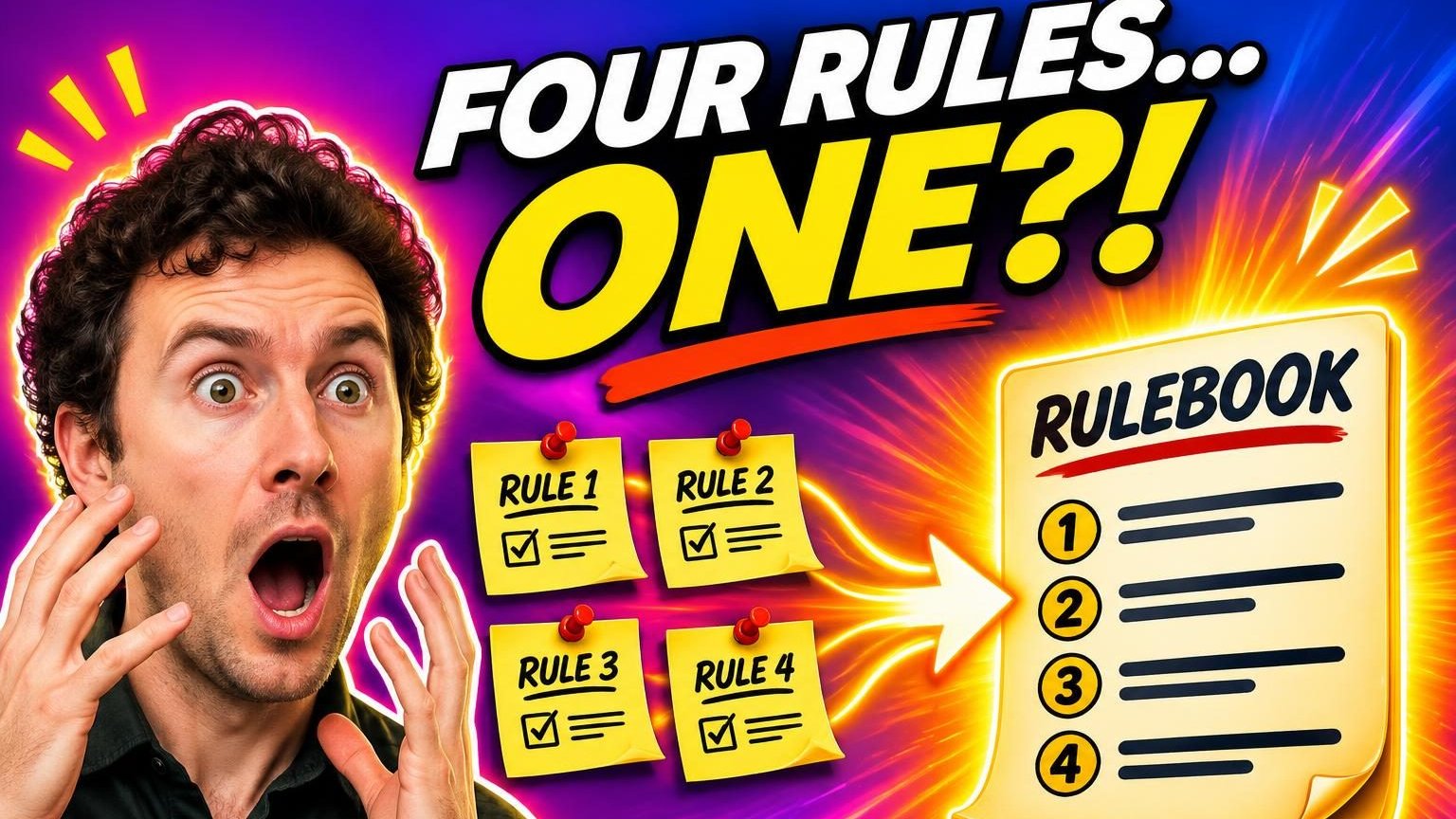
Every correction you give an agent wants to become a rule. Give it four in four hours and you have taught it four exceptions, not a habit.
The mind's standing instructions are a Markdown file in its config repo. When Misha corrects it, the mind edits that file in the same turn and commits, so the file is the sum of every correction so far. That is the right place for corrections to land. It also means the file grows the way a bug tracker grows: one case at a time, each written in the words of the moment that prompted it.
One day's history shows the problem clearly, and the fix.
Four rules in four hours
Over the morning and early afternoon, these lines were added to the instructions, each in its own commit:
- When passing on a detail found in a message, link to the message it came from.
- When suggesting places to go, include map directions links.
- Then, a few minutes later, a rewrite of that one: link the place's name itself, without a separate "directions" label; the link is hint enough. A few minutes after that, it was cut down to one short line.
- When referring to a coding session, link the words that refer to it to the session's page, keeping the phrasing natural.
Each rule was correct. Each was also a special case of the same thing, and each new one made the model a little more likely to treat linking as a set of exceptions rather than a habit. An agent reading four separate link rules learns that four kinds of thing get links. It does not learn what to do with a fifth.
One rule, with examples
The commit that ended the run deleted the specific lines and replaced them with one:
-When referring to a coding session, link the words that refer to it to its page.
-Format places as map directions links.
+When referring to something with a clear, useful destination URL, link its natural
+name, keeping the phrasing natural rather than adding a separate link label. For example:
+  - Coding sessions: their session page.
+  - Places he might want to go to: a map.
+  - Editable documents and checklists: the editor.
+  - Issues, pull requests and commits: their own page.
+  - Products: the specific product page.
+Choose the destination for the task: an editor for signing, a download for the file.
+Don't force links onto incidental mentions or repeat the same link throughout a message.
The shape is what matters:
- The principle comes first, and it is general. "Something with a clear, useful destination URL" covers the four earlier cases and the ones nobody has hit yet.
- The examples are examples. They carry the specifics that used to be rules (which destination for which kind of thing), but the list is introduced with "for example", so the model reads it as illustration, not as the whole list.
- The limits are stated. A principle that says "link things" invites a message where every noun is blue. Two lines bound it: not on incidental mentions, and not the same link over and over. A pile of special cases never needs limits, because each one is narrow. A general rule always does.
- The odd one stays odd. One earlier rule had a specific format (a separate "Source" link after a detail taken from a message). The rewrite keeps it as an explicit exception rather than forcing it into the general shape.
The same move happened again that evening with a different kind of rule. A line about how to set up a long-term reminder had been written around one occasion. Three minutes after it went in, it was rewritten to present that occasion as an example: the new wording says the case illustrates a principle rather than being a rule about that one occasion, asks for judgement on similar things, and names two of them. Same words, different status. The first version told the mind what to do about one thing; the second told it how to think about a class of things and gave it one worked case.
Why not just keep adding rules
Narrow rules are attractive because they are easy to verify: the correction was about X, the rule mentions X, done. The costs show up later and elsewhere:
- Gaps look like intent. If places and sessions are linked and documents aren't mentioned, a careful reader concludes documents shouldn't be linked.
- Overlaps conflict. The places rule went through three wordings in fifteen minutes. With several neighbouring rules, each rewording has to be checked against the others.
- The file stops being readable. Agents read the instructions every turn. A paragraph that says one thing well is cheaper to read, and easier for a person to review, than six lines that each say part of it.
The instructions already asked for some of this: change a rule in place, add a line only for something genuinely new, and never pile a contradiction on top of an old rule. What this day added in practice is the habit of noticing when the third or fourth rule on the same theme arrives, and stopping to write the principle that all of them were examples of.
A rule that was taken back
Not every idea about instructions survived the day. A line was added asking the mind, whenever it changed its instructions, to rerun the request that had prompted the change as a test of what the new instructions would have produced. It was removed nine minutes later, "pending design". That is probably the right call for a rule of that kind: replaying a request has side effects, and deciding what a replay may touch is a design question, not a sentence. Some things should be code before they are instructions.