Introducing Verbalist: a crossword you solve together
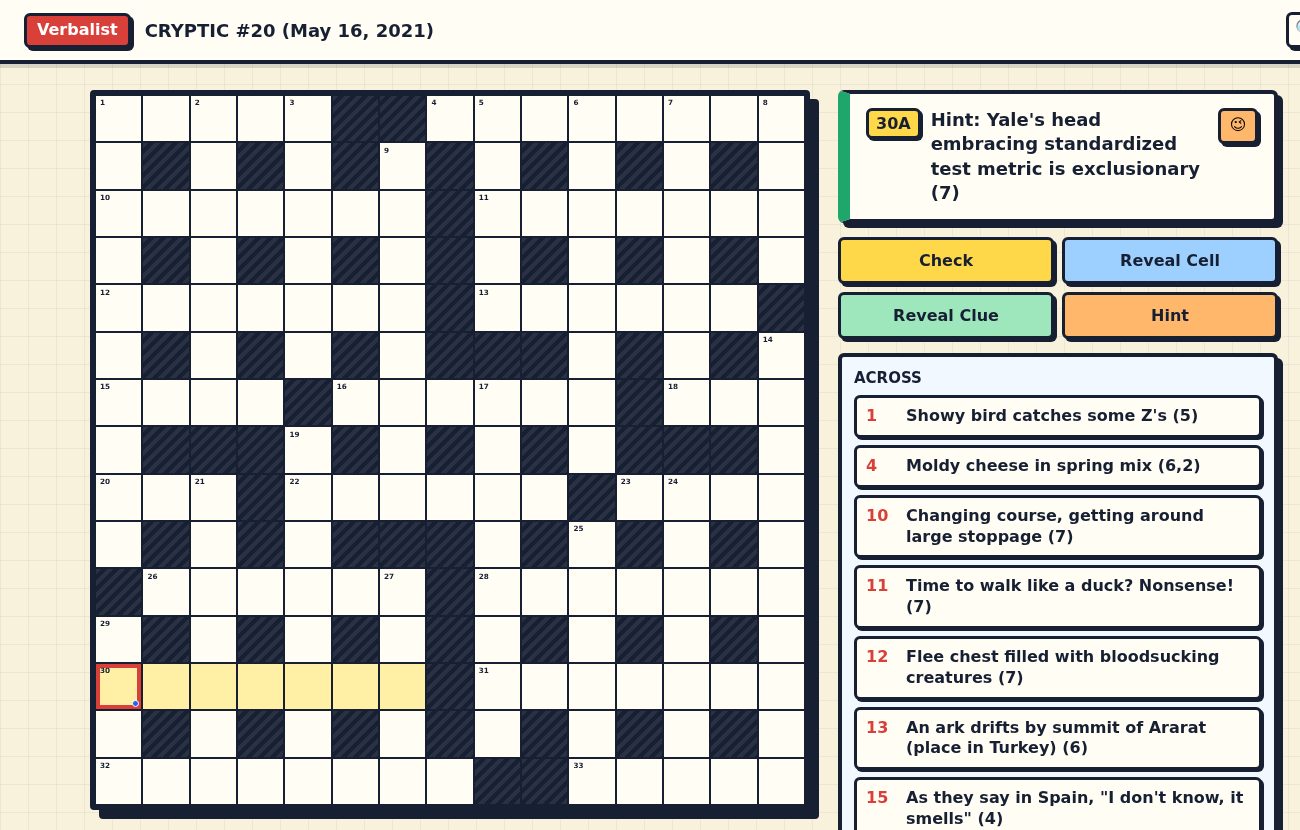
Here is a clue, seven letters, by Will Nediger, from The Browser's Cryptic #20 (May 2021):
Hint: Yale's head embracing standardized test metric is exclusionary (7)
It reads like a complaint about college admissions. That is the trick. In a cryptic crossword every clue is two clues at once: a plain definition at one end, and wordplay that builds the same answer out of pieces. The surface sentence is there to mislead you about where one ends and the other begins.
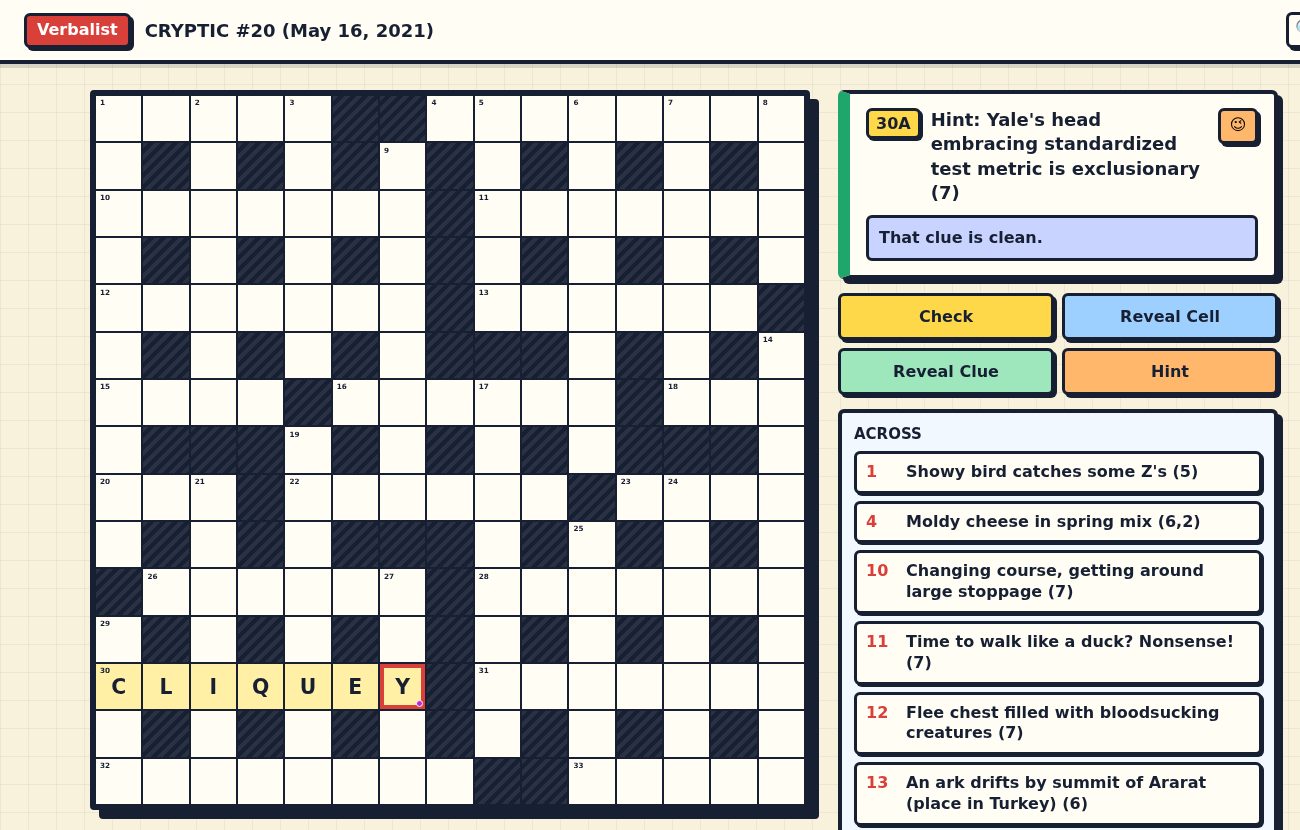
Take it apart:
- The definition is the last word: exclusionary. Seven letters meaning that.
- Hint is CLUE.
- Yale's head is the first letter of Yale: Y. Put it after the hint and you have CLUEY.
- standardized test metric is IQ, the number standardized tests are famous for.
- embracing puts IQ inside CLUEY: CL·IQ·UEY.
CL + IQ + UEY = CLIQUEY. The colon after "Hint" makes it look like a label, and the admissions-essay surface keeps you thinking about Yale rather than about one letter of it.
That clue, and the rest of that grid, is waiting in Verbalist, a crossword app built for solving together. Pick a puzzle, send the link to someone, and you are both working on the same grid. Letters appear as they are typed, and you can see where the other person's cursor is. It handles cryptic crosswords as well as regular ones, works on a phone, and can give a hint when a clue won't give.
It started as verbalist.app, and still runs there. The copy described here runs on Misha's iterate mind, beside its other apps. Most of its puzzles are human-written cryptics from The Browser; one, "Verbalist Cryptic #1", was written by a model, and is labelled as such.
How to play
The home page lists the available puzzles. Opening one starts a solution, which is your copy of the grid with its own address. The browser remembers it, so returning to the puzzle continues where you stopped. Sharing that address lets other people join that solution, not start their own. Everyone's letters sync live over a socket, and each player's cursor shows in the cell they are on.
Tap a cell or a clue to select it. Typing fills the active answer. On a phone, the app shows its own crossword keyboard and a dock for the current clue. A zoom button enlarges the active clue.
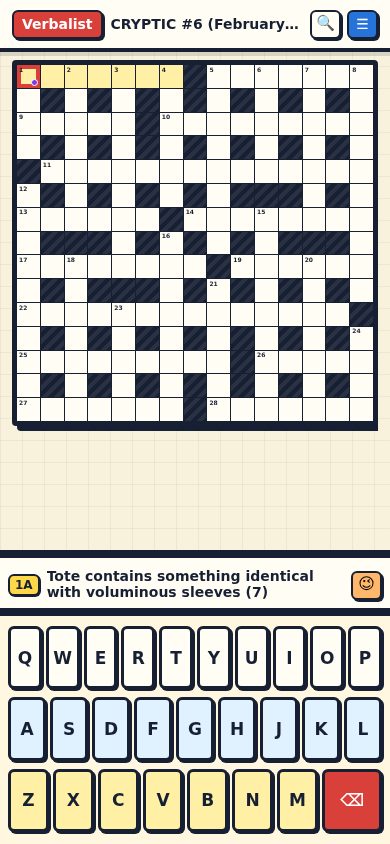
When you are stuck, there are a few levels of help, roughly from mild to drastic:
- Check marks the wrong letters in the current answer, or reports that the clue is clean.
- Hints asks Claude about the active clue. Another Hint asks again, and the earlier hints are sent along so the next one goes further, not over the same ground. For cryptic clues the hint model parses the clue in three steps.
- Reveal Cell and Reveal Clue fill in the answer, one letter or the whole entry.
Start over clears the grid and begins a fresh solution. You can also add your own crossword by uploading a .puz file.
How it is built
None of Verbalist's source is in the mind's config repo. The app is built in its own repo, and that repo's CI publishes a package, verbalist-iterate, for every pushed commit. The config pins one commit's build, the same way it pins other packages. Taking a newer version means changing that pin.
When it moved onto iterate on 6 October, one requirement was that nothing could be approximated. The client bundle is the same file verbalist.app serves, byte for byte. The app's own Playwright tests, on desktop and on a phone-sized viewport (typing, the mobile keyboard and clue dock, two browsers on one solution, uploads, hints), were run against a preview before the switch. Screenshots of a typed and checked cryptic puzzle matched verbalist.app's pixel for pixel.
What changed is where it runs. On Cloudflare the app had a database and one Durable Object per solution. On iterate, all of that is a single facet: one SQLite database for the puzzles and solutions, plus an in-memory record of who is playing. A facet can't hold a WebSocket, so the mind's worker holds each player's socket and long-polls the facet for updates to send down it. The wiring in the worker is a single call:
if (host === "verbalist") {
  return verbalistFetch(request, {
    assets, // the client's built files and the bundled puzzles
    getItx: () => this.getItx(),
    app: { context: "/verbalist", facet: "app", spec: { className: "VerbalistApp", mainModule: "verbalist.ts" } },
    hintsPerDay: 400,
  });
}
That integration needs three pieces together: the pinned package dependency, its built assets, and a root module exporting the database class. The last piece is easy to miss. In this build it is simply:
// A root module, available for the platform to load as a facet.
export { VerbalistApp } from "verbalist-iterate/app";
The host handler imports the package's server and assets; the facet spec in the first snippet points at this export. The worker hands the package an accessor for a scoped mind handle, rather than keeping an unreleased handle forever. Bundled puzzles seed a new database. A compatible package build and its asset bundle are prerequisites, not files that the integration code magically generates. To build a similar crossword without that package, the missing work is the puzzle parser, grid UI, database schema and collaboration protocol.
The two halves of live collaboration
The durable side stores puzzle definitions and solution letters in SQLite. Presence—the record of who is currently there—is in memory. The worker side holds browser sockets, which the facet cannot hold. This architecture pseudocode shows that division, not the package's exact RPC names or wire format:
async function bridge(browserSocket, solution, app) {
  const player = await app.join(solution);
  browserSocket.onMessage(async message => {
    // The durable side validates and applies the player's operation.
    await app.apply(solution, player, message);
  });
  let cursor = player.cursor;
  try {
    while (browserSocket.isOpen) {
      const batch = await app.waitForChanges(solution, cursor);
      cursor = batch.cursor;
      browserSocket.send(JSON.stringify(batch));
    }
  } finally {
    await app.leave(solution, player);
  }
}
The important distinction is between a puzzle and a solution. A fresh solution creates a new shared working grid; opening its link joins that grid. A durable implementation needs to associate every letter operation with the right solution and broadcast it only to that solution's players. A reconnect must recover the saved grid even when in-memory presence was lost. The sketch omits socket upgrades, operation validation, polling timeouts, reconnect handling and database transactions: those are requirements for a working implementation, not behavior supplied by the loop alone.
Hints go through the mind's AI gateway to Claude. The port was built to retain the original app's hint prompts and model choice. Because the app is public and anonymous, the model may write a fixed number of new hints per day. After that, the app's built-in fallback hints answer.
The hint flow can be reproduced independently of the socket bridge. This pseudocode describes the policy rather than a copy of the package's implementation:
async function nextHint(clue, previousHints) {
  if (dailyModelHintAllowanceExhausted()) {
    return builtInFallbackHint(clue);
  }
  return askClaude({
    clue,
    previousHints, // another hint should advance, not repeat itself
    instructions: crypticOrRegularHintPrompt(clue),
  });
}
The server needs the gateway's model credentials and billing configured; neither belongs in the client bundle. The budget limits newly generated hints, not every network request. A similar deployment still needs input validation and resource controls for public puzzle uploads and live connections. Treat a shared solution link as permission to collaborate, not a private account boundary, and expect presence to disappear on a restart while saved letters remain. The snippets deliberately leave out the full crossword client and prompt corpus; they identify the seams another implementation has to supply.
Known differences
A few things behave differently from verbalist.app, measured when it moved (historical observations, not current performance guarantees):
- A socket takes about 0.4 s to open here, compared with 0.15 s on Cloudflare. Once it is open, a typed letter comes back in about 60 ms.
- A page left open keeps the mind awake, because the worker polls the facet every 25 s. Cloudflare's sockets hibernate.
- The first request after a new build is pinned takes several seconds while the package loads.
- It started with a fresh database: the bundled puzzles are seeded, and nothing played on verbalist.app was carried over.